Paddle out at any busy break and you join a society with rules nobody ever wrote down. Surf etiquette is the code that keeps a crowded line-up safe and stops it turning into a free-for-all: who gets the wave, where you paddle, and how you behave when you get it wrong. Break the code and you will hear about it, sometimes loudly. Follow it and you will catch more waves, make friends in the water and stay out of trouble.
These are the ten rules that matter most, with what they look like in practice at South African breaks, from the crowded peaks of Muizenberg to the point at Jeffreys Bay.
Why surf etiquette matters
A surfboard is a few kilograms of foam and fibreglass with sharp fins, often travelling faster than a jogger. Put fifty of them on one peak and the potential for collisions is obvious. Etiquette exists first for safety and then for fairness. There are only so many good waves in a set, and the rules decide who gets them without an argument every time.
The good news is that the rules are simple and the same almost everywhere in the world. Learn them once and you can paddle out with confidence from Durban to Bali.
Priority: who gets the wave
1. The surfer closest to the peak has priority
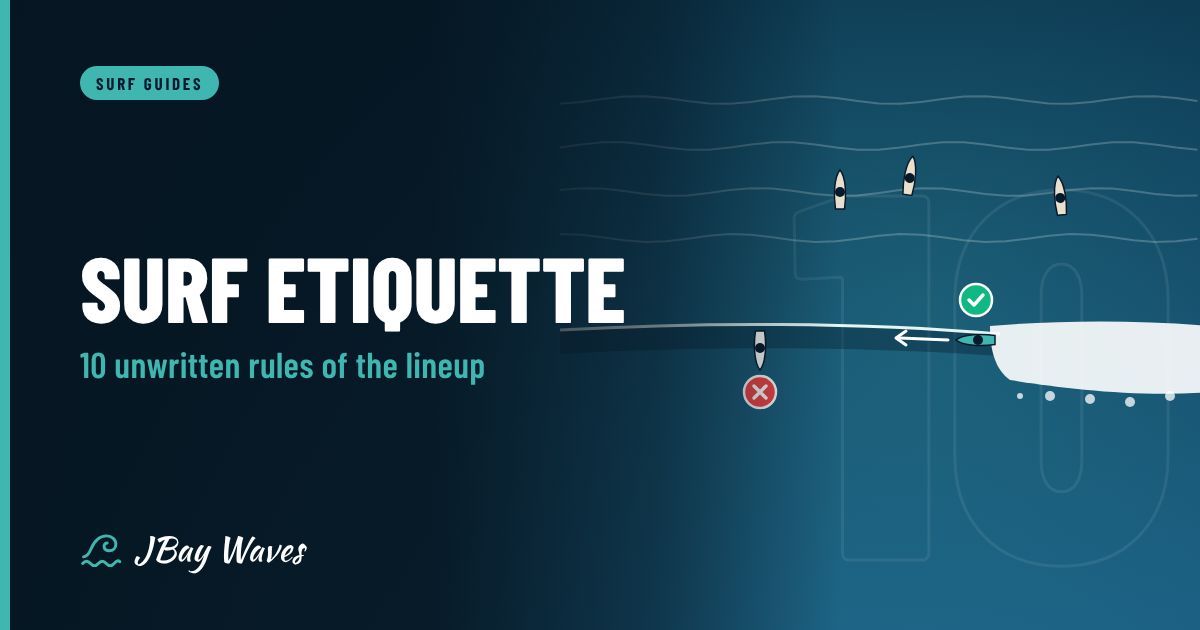
The surfer positioned closest to where the wave is breaking, the peak or curl, has the right of way. On a point break like J-Bay that means whoever is deepest, furthest up the point. On a beach break peak that breaks both ways, one surfer can go left and another right, as long as each stays on their own side. Being first to your feet only settles it when two surfers are equally close to the peak.
At well-run breaks there is also a rotation. Once you have caught a wave and paddled back, you join the back of the queue rather than paddling straight to the inside to take the next set.
2. Never drop in
Dropping in means taking off in front of a surfer who has priority and is already riding, or about to ride, the same wave. It is the cardinal sin of surfing. It ruins their wave, and at speed it causes collisions, broken boards and injuries. Before you commit to any wave, look towards the peak. If someone is up and riding or paddling with intent, pull back. If you drop in by accident, kick out immediately and apologise.
3. Don't snake
Snaking is the sneaky version of a drop-in: paddling around someone who is waiting so that you end up on the inside, closer to the peak, and can claim priority on the next wave. Doing it once might be an accident. Doing it repeatedly to the same person is a quick way to make enemies. Earn your position by waiting your turn.
Paddling out and staying safe
4. Paddle wide, not through the line-up
Use the channel, the deeper water where waves are not breaking, or paddle around the peak rather than straight through it. If you are caught in front of someone riding a wave, paddle towards the whitewater behind them rather than into their path, even if it means taking the wave on the head. Never sprint for the open shoulder they are heading for; that is exactly where they will be in a second.
At point breaks the polite option is often to get out of the water and walk back up. At J-Bay, surfers come in through the rocks and walk back up the point rather than paddling against the current through everyone's waves.
5. Hold on to your board
A loose board is a missile. Duck-dive or turtle-roll through waves instead of throwing your board away, and if you do have to bail, check behind you first. In the shallows, hold your board beside you rather than between you and an oncoming wave. Wear a leash and check it and the leash string regularly, especially on longboards and stand-up paddleboards, which carry a lot of weight when they get loose.
Sharing the waves
6. Take turns and don't hog the peak
Being able to catch every wave does not mean you should. Longboarders, stand-up paddlers and strong paddlers can sit wider and catch waves earlier than everyone else, which is exactly why the respectful thing is to take a set wave and then let others have theirs. Party waves, with several surfers sharing one ride, only happen at mellow spots when everyone is clearly up for it.
7. Respect the locals and the vibe
Local surfers surf their break every day, often in conditions you will never see. That does not give anyone the right to threaten visitors, but it does earn them some deference. Arrive with a smile, sit wide for the first while and watch how the line-up works. Take the waves that come to you rather than the best set of the day, and do not descend on a small peak with five mates.
At heavy local spots such as Boneyards and Supertubes, the regulars will be deeper and better than you, and the line-up runs on that pecking order. Our guide to how Supertubes works explains what that looks like on the point.
Communicating in the water
8. Call your wave and own your mistakes
A quick call clears up most confusion. On a peak that breaks both ways, call "left" or "right" so the surfer on the other side knows where you are going. If you are paddling for a wave and someone deeper is too, a shout of "going" makes things clear, and so does a nod to let them have it.
When you get it wrong, and everyone does, a genuine "sorry, my bad" defuses most situations instantly. Arguing that you were there first does not.
Knowing your limits
9. Surf breaks that match your ability
The fastest way to annoy a line-up, and to get hurt, is to paddle out somewhere beyond your level. A beginner who cannot turn or stop is a hazard at a crowded reef, however good their intentions. Learn on sandy beaches with surf schools and lifeguards, move on to softer waves once you can ride along the face, and save the heavy breaks until you can take off late and get out of the way of others. Our beginner's guide to your first ten sessions maps out that progression.
10. Look after each other and the beach
If someone is in trouble, help: paddle over, let them hold your board for flotation, and alert lifeguards or call the NSRI emergency line on 087 094 9774 (or 112 from a mobile). Know how to recognise and escape a rip current yourself; our guide to rip currents and how to get out of one covers it. On land, take your rubbish home, keep off the dunes and park considerately.
On lifeguarded beaches, swimmers belong between the red and yellow flags. Many beaches also mark separate areas where boards are allowed, so keep your board out of the bathing zone.
Surf etiquette at J-Bay and other South African breaks
The rules are universal, but every break has its own flavour.
- Jeffreys Bay: at Supers the deepest surfer has priority, and they are moving fast, so never sit down the line at the Car Park section and paddle for waves someone is already riding. The Point is home to the town's longboarders, and Kitchen Windows breaks both ways, so call your direction. Our live report for The Point shows when the friendlier end of the bay is working.
- Muizenberg: surf schools and beginners are everywhere, so give learners space and expect boards to go astray. Shark Spotters watch the beach every day of the year: a white flag with a black shark means a shark is in the area, and a siren means get out of the water calmly and quickly.
- Durban and KwaZulu-Natal: on lifeguarded beaches, bathing and surfing areas are often marked separately, and municipalities can close beaches to bathing and surfing when shark nets or drumlines are damaged. Respect the flags and any bans.
| Situation | The right move |
|---|---|
| Someone deeper is paddling for the same wave | Pull back and let them go |
| You drop in by accident | Kick out straight away and apologise |
| You are caught inside as a surfer rides towards you | Paddle for the whitewater behind them, not the shoulder |
| A peak breaks both ways with a surfer on each side | Call your direction and stay on your side |
| You have just caught a set wave | Paddle back to the end of the queue |
| Someone is struggling in the water | Help them, then get a lifeguard or call 112 |
When it goes wrong
Follow every rule and someone will still shout at you eventually. Stay calm, apologise if you were wrong, and if you were not, paddle away rather than escalating. No wave is worth a fight, and physical aggression is assault whether it happens on land or at sea. If someone threatens you, leave the water and report it to the police on 10111.
Most line-ups are far friendlier than their reputation, especially if you smile, say hello and show you know the rules. For a printable summary of etiquette and the basics, download our free Learn to Surf: The Beginner's Playbook.
The best breaks feel like a community that carries on into the car park, the braai and everything in between. Wait your turn, never drop in, paddle wide, hold your board, say sorry when you get it wrong and help anyone in trouble. If you want to wear that spirit out of the water, our Find Your Wave tees say it without a word.