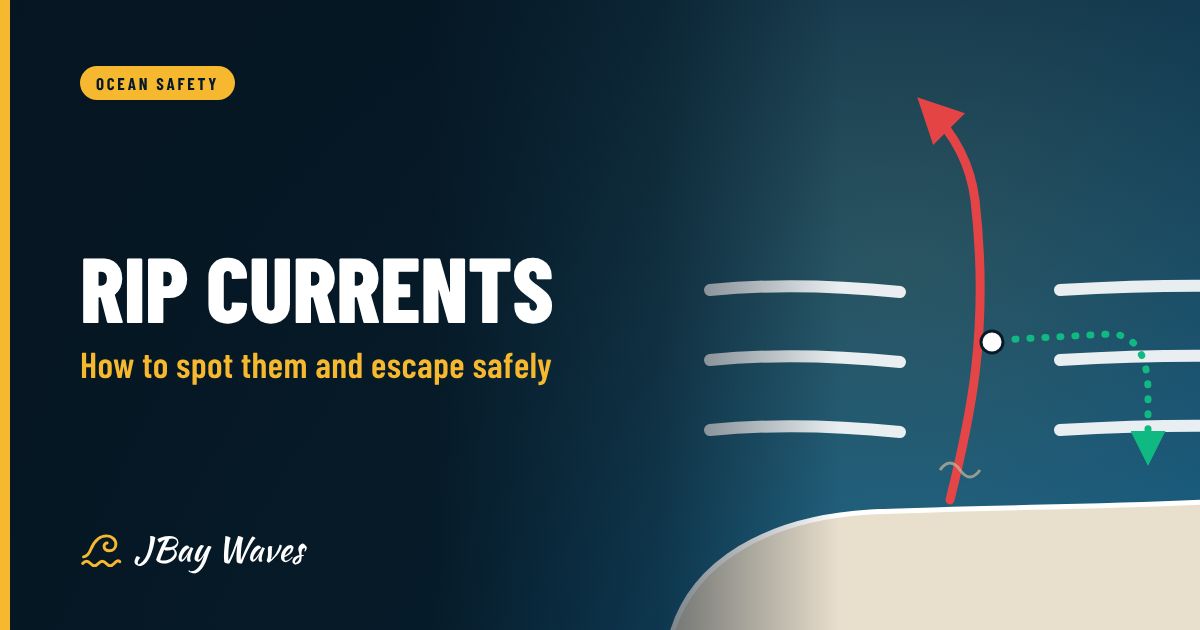
Most people who get into trouble at the beach are not caught out by a giant wave. They are swimming, bodyboarding or learning to surf on a pleasant day when the water around them starts moving the wrong way, and the beach gets further away no matter how hard they swim. Rip currents are the hidden hazard on almost every surf beach in South Africa. The good news is that they follow predictable rules. Once you know how to spot a rip and how to escape one, you can enjoy the water with far more confidence, and help others do the same.
What is a rip current?
The NSRI describes rip currents as rivers of water flowing from the beach back out to sea, and they occur wherever waves break. Every wave pushes water up the beach, and that water has to get back out. It finds the easiest route, usually a deeper channel between sandbanks or a path along rocks, a reef or a pier, and it flows seaward in a concentrated stream.
A rip has three parts: feeder currents running along the beach, the neck, where the flow is narrowest and fastest, and the head, where it spreads out and weakens beyond the breaking waves. According to the NSRI, rips can move at up to 2 metres per second, faster than most people can swim, and range from a few metres to more than 100 metres wide.
Two myths are worth clearing up. A rip does not pull you under; it pulls you away from the shore, and as the NSRI puts it, as long as you can float you will be safe. And it is not a rip tide. The NSRI keeps that term for the tidal flows through narrow openings such as estuary mouths. A rip current is driven by waves, so it can appear on any tide.
The main types of rip currents
Channel rips on sandy beaches
The most common kind. Waves break on the sandbanks and the water drains out through the deeper gaps between them. Channel rips can stay in the same place for days or weeks, then shift when a big swell rearranges the sand.
Fixed rips beside rocks, reefs and piers
Hard structures deflect the water seaward, so a rip often runs along the edge of a rocky point, a reef or a pier. Because the structure does not move, these rips are reliable, which is exactly why surfers use them to get out the back.
Flash rips
Short-lived rips that appear when a set of bigger waves dumps extra water on the beach, then fade within minutes. They can form on a beach that looked safe a moment earlier, which is why you should keep watching the water.
Big-swell rips
When a large swell hits a beach between two headlands, the volume of water returning to sea can be enormous, and the rip can run far beyond the breaking waves. On those days, stay out unless you are an experienced surfer who knows the beach.
How to spot a rip current from the beach
Before you swim or paddle out, spend five to ten minutes watching from the highest spot you can find, such as a dune, a car park or a lookout. Polarised sunglasses help you see through the glare. Watch through a few sets, because a rip that is invisible between sets can be obvious when the waves arrive.
| Sign | What it looks like | Why it happens |
|---|---|---|
| Different-coloured water | A darker, deeper-looking channel, or a murky, sandy plume | Deeper water, or sand stirred up and carried seaward |
| Fewer breaking waves | A gap where waves do not break, with whitewater on either side | Waves break less over the deeper channel |
| Debris moving out | Seaweed, foam, sand clouds or debris drifting out towards the backline | The current is carrying it |
| Rough surface | Choppy, turbulent water in a channel or river-like shape | The seaward flow meets the incoming waves |
The calm-looking gap is the trap. To an untrained eye, the patch of water with no breaking waves looks like the safest place to swim, when it is often the rip itself. A rip can also flow at an angle or bend before it reaches the breakers, so do not assume it runs straight out. If you are unsure, ask the lifeguards; pointing out rips is part of their job.
When rip currents are strongest
- Bigger swells. More wave energy pushes more water onto the beach, and more water has to rush back out.
- Lower tides on sandbank beaches. With less water over the sandbanks, the return flow is squeezed into the channels.
- After storms. Big seas reshape sandbanks and cut new channels, so a familiar beach can behave differently.
- Near structures and river mouths. Rocks, piers and estuary mouths all concentrate flowing water.
Checking the swell size and tide on our live surf reports before a beach day takes a minute and tells you a lot. If you want to understand what the numbers mean, our guide on how to read a surf forecast explains swell height, period and tides.
How to escape a rip current
If you feel yourself being carried away from the beach, these steps, based on NSRI advice, will get you out of trouble:
- Stay calm. Panic is the real danger. Force yourself to relax and breathe; the rip will not drag you under.
- Float. Lie back, keep your head up and let the water hold you. Floating saves energy and gives you time to think.
- Do not swim straight back to the beach. Swimming against the current wears out even strong swimmers.
- Work out which way it is pulling. Look at the beach to judge the direction of the flow.
- Swim at right angles to the current. Swim parallel to the beach, slowly and steadily, towards the "riverbank" where waves are breaking.
- Let the waves bring you in. Once you are out of the pull, swim or body-surf back to shore with the breaking waves.
- Signal for help if you need it. If you cannot get out, keep floating, raise one arm and wave to the lifeguards or people on the beach.
Rip currents and surfers
Surfers have a complicated relationship with rips. A good rip is a free ride out the back, and at many breaks the locals paddle out in the channel beside the rocks or the sandbank to save their arms. That works when you know the beach and you are on a board that keeps you afloat.
- Stay with your board. It is a big flotation device. If you are pulled out, sit on it, catch your breath and paddle across the current towards the breaking waves.
- Plan for a snapped leash. Without the board you are a swimmer again, so float, stay calm and swim parallel to the beach as above. Check your leash and string regularly.
- Beginners, learn between the flags. Choose a lifeguarded beach and stay in the whitewater on the sandbanks, away from the channels. Our beginner's guide to your first 10 sessions covers choosing a safe spot.
- Use your board to help, carefully. The NSRI lists a surfboard, like a Pink Rescue Buoy, as flotation that trained people can use in a rescue. If you reach someone, keep the board between you, let them hold the front, and paddle across the current, not against it.
If someone else is caught in a rip
Every year, people drown trying to rescue someone else. The NSRI's advice is clear: do not go in after them unless you are trained and have flotation.
- Call for help immediately. Phone 112 from a mobile, or the NSRI emergency number, 087 094 9774. Alert the lifeguards if they are on duty.
- Throw something that floats. A bodyboard, a cooler box or a Pink Rescue Buoy can keep them afloat until help arrives.
- Keep your eyes on them. Point at the person so rescuers can see where they are, and keep telling them to float.
Since 2017 the NSRI has installed bright pink Pink Rescue Buoys at beaches, rivers and dams around the country. Each pole carries an identification number and the NSRI emergency number, so rescuers can find the exact location quickly. Learn where the nearest one is at the beaches you use, and never take one except to save a life.
What to tell the emergency operator
Stay on the line and keep it simple. Give the name of the beach and a landmark, such as a lifeguard tower, a car park or the number on the nearest Pink Rescue Buoy pole. Say how many people are in trouble, what they are wearing or holding, and which way the current is carrying them. Then keep watching and keep your phone free so the rescuers can call you back.
Rip-smart habits for every beach day
- Swim at beaches where lifeguards are on duty, and stay between their flags.
- Never swim alone, and keep children within arm's reach in the water.
- Watch the water for a few minutes before you go in, every time.
- Skip the swim if you have been drinking, and stay out on big, messy days.
- Teach children to float, raise an arm and wait for help if they are carried out.
Our free Beginner's Playbook puts the safety basics for new surfers in one place, from choosing a spot to reading the water.
"Live by the tide" is printed on the back of one of our JBay Waves tees, but on a beach day it is practical advice. Know the tide, the swell and where the rips are before you go in. If you do get caught: relax, float, swim across the current and signal for help. Share these steps with the people you swim with, especially the kids.