Walk into any surf shop and you will hear litres before you hear anything else. "What are you riding, 32? Try a 35." Surfboard volume has become the quickest way to describe how much a board will float you, and getting it right is one of the biggest equipment decisions you will make. Too much and the board feels like a barge in good waves. Too little and you miss waves, paddle twice as hard and stop improving.
This guide explains what volume actually measures, gives you a litres-by-weight table to start from, and then shows how fitness, age, wave type and even a winter wetsuit should nudge the number up or down.
What surfboard volume actually measures
Volume is simply the amount of space a board takes up, measured in litres. Most boards are designed on computer software these days, so the volume is calculated precisely and written on the stringer or listed by the shaper.
Why it matters is basic physics. Every litre of seawater a board pushes aside supports roughly a kilogram of weight. A 30-litre shortboard cannot float a 75 kg surfer sitting still, which is why it sinks under you when you sit on it, but once you are paddling and moving it planes across the surface.
The more volume a board has relative to your weight, the higher it sits, the faster it paddles and the earlier it catches waves. The trade-off is that more foam is harder to put on a rail, harder to duck-dive and less responsive in steep, powerful surf.
The guild factor: a simple starting point
A popular way to turn your weight into a target volume is the guild factor: litres of board per kilogram of body weight. Multiply your weight by the factor for your level and you have a starting point.
Your weight in kg × guild factor = suggested volume in litres
Different shapers and calculators publish slightly different factors, so treat these bands as a guide rather than a rule:
- Learning (soft-tops and longboards): about 0.9 to 1.1, or roughly your body weight in litres.
- Progressing (catching green waves, mid-lengths): about 0.6 to 0.8.
- Intermediate (turning confidently, surfing most weekends): about 0.45 to 0.55.
- Advanced (performance surfing, all conditions): about 0.38 to 0.44.
- Expert (fit, surfs constantly, high-performance boards): about 0.33 to 0.37.
Be honest about your level. It is tempting to put yourself a band higher than you really are, and the board you buy pays for it.
Surfboard volume by weight and ability
Here are those bands worked out for common body weights. Use them for your everyday board in average waves, then adjust using the next section.
| Weight | Learning | Progressing | Intermediate | Advanced | Expert |
|---|---|---|---|---|---|
| 50 kg | 45 to 55 L | 30 to 40 L | 22 to 28 L | 19 to 22 L | 16 to 18 L |
| 60 kg | 54 to 66 L | 36 to 48 L | 27 to 33 L | 23 to 26 L | 20 to 22 L |
| 70 kg | 63 to 77 L | 42 to 56 L | 32 to 38 L | 27 to 31 L | 23 to 26 L |
| 80 kg | 72 to 88 L | 48 to 64 L | 36 to 44 L | 30 to 35 L | 26 to 30 L |
| 90 kg | 81 to 99 L | 54 to 72 L | 40 to 50 L | 34 to 40 L | 30 to 33 L |
| 100 kg | 90 to 110 L | 60 to 80 L | 45 to 55 L | 38 to 44 L | 33 to 37 L |
Adjusting the numbers for real life
Fitness and how often you surf
Paddle fitness is the biggest variable the tables cannot see. Someone who surfs five days a week can ride a lot less foam than someone of the same weight and skill who gets in twice a month. If you surf less often than you used to, or you are coming back after a break, go up a band. Building your paddling strength out of the water is the other way to close the gap; our surf fitness exercises are a good place to start.
Age
As the years add up, flexibility and paddle power usually drop, and volume picks up the slack. Plenty of surfers in their forties and beyond surf better on a slightly fuller board, because they catch more waves and arrive on their feet with more time to set up.
The waves you surf
Small, soft, crumbly waves need more volume to generate speed, which is why groveller and fish shapes carry plenty of foam in a short length. Powerful waves do more of the work, so on an everyday shortboard you can afford less volume and gain control.
Big, fast waves are the exception. A step-up for solid days, the kind of board you want for a big day at Supertubes in Jeffreys Bay, usually carries a little more volume than your everyday board, mostly through extra length, so you can paddle in early and stay ahead of the curl.
Wetsuits and water temperature
A thick winter steamer, booties and a hood add weight and make paddling harder, so a little extra foam makes sense for cold-water boards. A litre or two is plenty for most people. If you surf the Cape's Atlantic side in a 5/4 all year, factor that in; if you surf warm KwaZulu-Natal water in boardshorts, you can go a touch lower. Our wetsuit thickness guide for South African water covers what you will be wearing where.
Construction
Epoxy and EPS boards are lighter than traditional polyurethane boards and tend to feel more buoyant at the same volume, so some surfers size them half a litre to a litre smaller. Soft-tops carry so much foam that construction rarely matters while you are learning.
Where the volume sits matters as much as how much
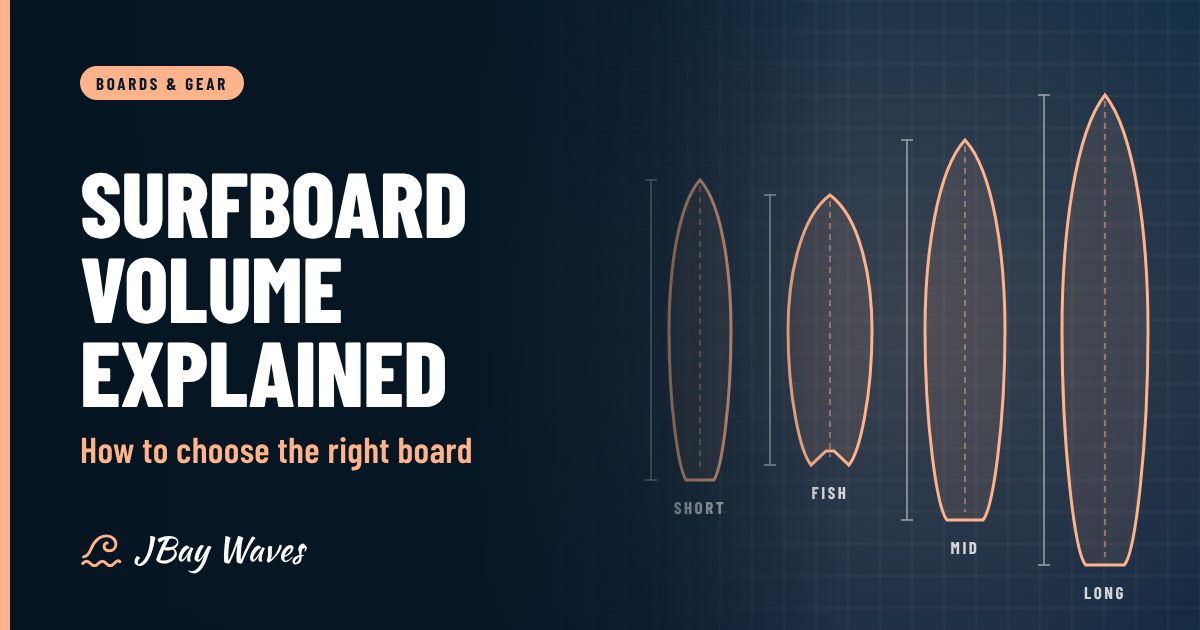
Two boards with identical volume can feel completely different. A 6'2" and a 5'8" can both be 33 litres, but one has it spread over length and the other packed into width and thickness. Where the foam sits changes how a board paddles and turns:
- Length adds paddle speed and glide, and helps you get into waves early.
- Width adds stability and lift in small waves, but wide boards can feel slow from rail to rail.
- Thickness adds float but can make a board corky and hard to sink into a turn.
- Rails matter too: full, boxy rails hold more volume and feel forgiving, while thin rails bite harder in steep waves.
You can estimate volume by multiplying length, width and thickness in inches by a shape factor of roughly 0.54 to 0.72 and then by 0.016387 to convert cubic inches to litres. Run that for a 6'2" × 19½" × 2½" board and you get anything from about 32 to 43 litres, which is exactly why the shaper's listed volume beats guesswork.
Matching volume to board type
- Soft-tops and longboards: maximum float for learning and small waves. Learning-band volume or more.
- Mid-lengths and mini-mals: the classic second board, with easy paddling and room to learn turns. Progressing band.
- Fish and grovellers: short, wide and full for small or weak surf. Upper end of your intermediate or advanced range.
- Everyday shortboards: the board for average to good waves. Your core band.
- Step-ups and guns: longer, narrower boards for big, powerful surf, with a touch more volume than your shortboard.
A sensible quiver for most South African surfers is an everyday board plus one fuller board for small days. Add a step-up when you start chasing solid swells at places like J-Bay.
Three worked examples
A 78 kg intermediate who surfs Cape Town beach breaks most weekends. The intermediate band gives 35 to 43 litres. Winter means a 4/3 or 5/4 with booties, so aim for the upper half, around 40 to 43 litres, in a forgiving hybrid or groveller shape.
A 65 kg advanced surfer planning a winter trip to Jeffreys Bay. The advanced band gives about 25 to 29 litres for an everyday board. For solid days at Supertubes, a step-up a few inches longer with a litre or two more volume will help them get in early on the fast, walling take-offs.
A 92 kg beginner buying a first board. The learning band gives about 83 to 101 litres. That points to a soft-top of 9 feet or more, not the 8-foot board a lighter friend might be riding. Our beginner's guide to your first ten sessions explains how to use it.
Common surfboard volume mistakes
- Going small too soon. The fastest way to stop progressing is a board that catches half the waves.
- Buying a pro model. Professional surfers' boards are built for elite fitness and perfect waves.
- Ignoring your real surf frequency. Size for the surfer you are this year, not the one you were at 21.
- Looking only at litres. Length, outline, rocker and rails change how that volume behaves.
- Forgetting the conditions. One board rarely suits both knee-high summer mush and a solid winter point.
Before you buy, borrow or rent boards in your target range and surf them in your usual waves. Our free Learn to Surf: The Beginner's Playbook covers the gear you need to get started, including your first board.
Find your weight in the table, be honest about your level, then adjust for fitness, waves and water temperature. Use the live surf reports to decide which board to grab each morning, and spend what you save by not buying the wrong board on a road trip. A couple of Live By The Tide tees for the drive would not hurt either.