On a solid winter swell, lines march up from the Southern Ocean, bend around the reef and peel down the point at Jeffreys Bay for hundreds of metres, one right-hander after another. Surfing Jeffreys Bay on a day like that is the reason people fly halfway around the world to a small town in the Eastern Cape.
This is the overview we wish we'd had on our first trip: every break from Kitchen Windows to Albatross, which ones suit your level, the conditions that make them work, when to come and how to fit into the line-up.
If you want the deep detail on the famous bit, read our section-by-section breakdown of how Supertubes works. For timing your trip, our month-by-month guide to the J-Bay season has the full calendar. Everything else starts here.
Why surfing Jeffreys Bay is on every surfer's list
J-Bay is a right-hand point break, and a very long one. The coast here runs roughly north to south with the Indian Ocean on the east side, and the swells that matter arrive from the south-west. They reach the reef at an angle and peel along it instead of closing out. The point stretches for several kilometres, from Kitchen Windows near the town centre to Albatross at the far end, and it breaks in a string of named sections.
The headline section, Supertubes, breaks for about 300 metres on its own. On the right swell with a clean wind it links with Boneyards above and Impossibles and Tubes below, and surfers have ridden from Boneyards all the way to The Point, a ride of more than a kilometre. Those days are rare; usually the wave sections and you paddle back for another.
It is also remarkably consistent. The same cold fronts that bring Cape Town its winter rain send swell up the coast for months on end, and through the core of the season it is hard to find a truly flat day. For regular-footers it is the ultimate forehand wave.
The history runs deep. Longboarders were riding the Point in the early 1960s, and by the late '60s and early '70s the town had become a hangout for travelling surfers. Supertubes has hosted world tour contests on and off since the 1980s. The WSL's J-Bay Open ran most recently in July 2025 but was left off the 2026 Championship Tour after funding fell through, and the town hopes to see it back.
The breaks of J-Bay, from the top of the point to the bottom
Locals split the point into named sections. From the top end near town to the far end, these are the ones that matter. Smaller sections such as Salad Bowls and Coins sit between Impossibles and Tubes and only stand out on certain swells.
Kitchen Windows
A reef break beside Main Beach, close to the town centre, with short, punchy lefts and rights and an easy paddle out. It works through most tides and gives intermediates a fun option away from the main point, though it fills up when everything else is crowded. Watch the rocks on the way in and out.
Magnatubes
A shifty stretch of reef between town and Boneyards that throws fast, hollow, hard-breaking rights on a south-west swell, with the odd short left. Rides are short and it closes out often, but on its day it is properly heavy. It prefers mid to higher tides, and there are sharp rocks and mussel shells everywhere.
Boneyards
The top of the main point and the start of the famous stretch. Boneyards jacks up over shallow reef into a steep, fast take-off that pitches and sucks hard, and when a big swell has plenty of west in it, the take-off shifts up here and the wave can run straight into Supertubes. It is a tight peak dominated by local surfers who know every rock. Visitors should watch a session or two before even thinking about it.
Supertubes
The wave on the posters. Supers is a long, fast, hollow wall, and its Car Park section produces the best barrels on the point. It is crowded whenever it is good and suits advanced and expert surfers only: the take-off is critical, the wall runs faster than most people have ever surfed, and the reef underneath is shallow and coated in mussels.
Impossibles
The section below Supertubes earns its name honestly. The wave races ahead so quickly that it rarely lets anyone through, but on the right swell and tide it serves up some of the best barrels on the point to surfers who can hold a high line at full speed. It breaks close to the rocks and punishes mistakes.
Tubes
A shorter, intense barrelling section that works best on a medium-sized swell. With more defined take-off zones and fewer people than Supers, it is the choice for good surfers who want tubes without fighting the main pack.
The Point
Where J-Bay surfing started. The Point sits in a cove, so its walls are slower and more forgiving than the sections up the reef, and it is home to the town's longboarders and plenty of shortboarders on smaller days. It handles a wide range of swell sizes and is the right call for competent intermediates. It is not a learner wave: the reef is still there, and it gets busy.
Albatross
The last section of the point and the softest wave in town, a mellow right that leans partly on sand banks and needs a decent swell to break properly. It is usually the quietest option and a good place for intermediates and longboarders to find waves of their own.
Main Beach and Dolphin Beach
If you are new to surfing, skip the point altogether. The sandy beach in front of town is where J-Bay's surf schools teach, with no reef underfoot and lifeguards on duty at the Blue Flag beach in season.
| Break | What it does | Suits | Crowds |
|---|---|---|---|
| Kitchen Windows | Short lefts and rights over reef | Intermediates | Busy when the point is packed |
| Magnatubes | Fast, hollow, shifty rights | Advanced | Smaller, very local crew |
| Boneyards | Steep, hollow take-off that can link to Supers | Advanced to expert | Local-dominated |
| Supertubes | Long, fast, barrelling wall | Advanced to expert | Packed when it is on |
| Impossibles | Very fast, hollow section | Expert | A small, skilled crew |
| Tubes | Short, intense barrels | Advanced | Lighter than Supers |
| The Point | Slower, forgiving walls | Intermediates, longboarders | Busy |
| Albatross | Soft, sand-influenced right | Intermediates, longboarders | Usually the quietest |
| Main Beach | Sand-bottom beach break | Beginners | Surf schools |
What makes J-Bay fire: swell, wind and tide
J-Bay's recipe is simple enough to memorise:
- Swell: long-period groundswell from the south-west, generated by the low-pressure systems and cold fronts that sweep below Africa in winter. Periods of 12 seconds or more line the point up best, and the main sections need some size, roughly 4 ft and up, before they come alive. The point is well sheltered from straight westerly swell, so direction matters as much as size.
- Wind: westerly to south-westerly. A light to moderate south-westerly blowing slightly behind the wave line is the classic J-Bay wind and grooms the faces beautifully. North-westerly to northerly berg winds, the warm, dry "devil winds" that blow off the interior a day or so before a cold front arrives, blow into the face at Supers and put chop on it. Easterlies and north-easterlies are onshore.
- Tide: the point works on all tides. Lower tides make the reef sections faster and hollower, higher tides fill them in, and many regulars like a rising tide.
In summer the wind swings into the east for days at a time, the surf shrinks, and the water can turn cold almost overnight as those easterlies draw deep water up along the coast.
When to go
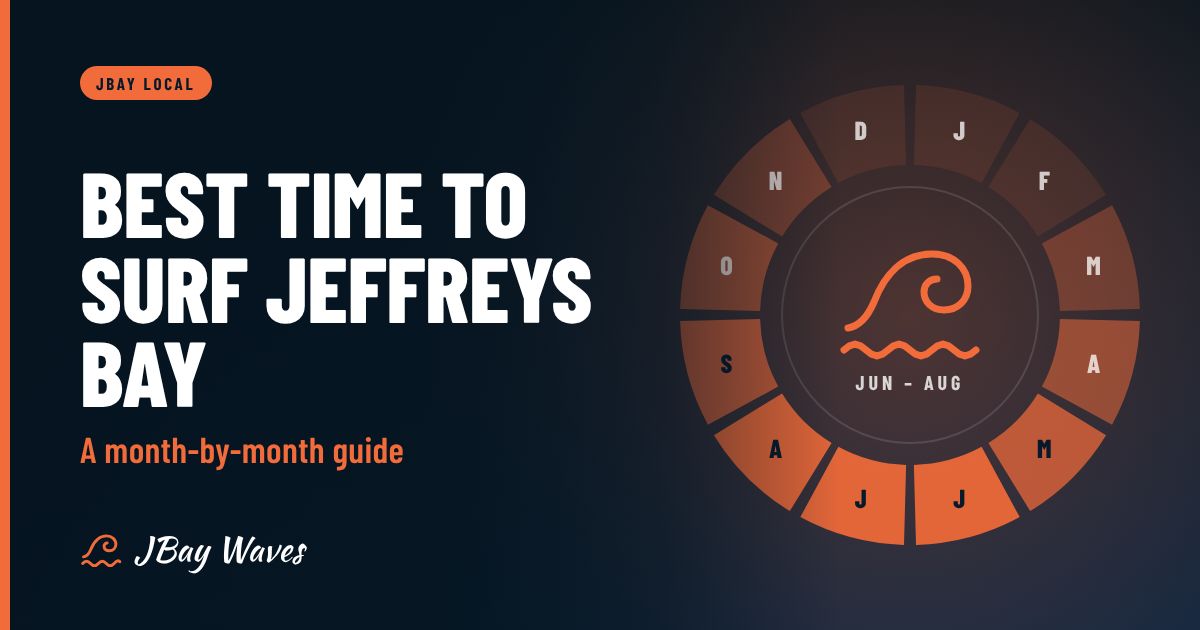
May to September is the season, with June, July and August the most reliable months for size and offshore wind. April and October can be excellent with fewer people in the water. Summer is warm and lively in town, but the surf is smaller and the easterly wind messes up plenty of days, so early mornings are your best bet.
Crowds follow the swell and the calendar. South African school holidays (mid-December to mid-January, around Easter, and a three-week break from late June into July) fill the town, and the winter peak brings surfers from all over the world. If you can only come once, a two-week window between June and August gives you the best odds of scoring a proper swell.
Planning your trip: getting there, getting around and where to stay
The nearest airport is Chief Dawid Stuurman International in Gqeberha (formerly Port Elizabeth), about an hour's drive up the N2, with regular flights from Johannesburg, Cape Town and Durban. Driving from Cape Town takes the better part of a day along the Garden Route, with plenty of waves on the way.
You will want your own wheels. The breaks are spread over several kilometres, the swell can turn on at any hour, and nobody wants to carry a board bag through town. A car with roof racks is fine; a bakkie is better.
Where you stay depends on your priorities. The streets behind Supertubes are full of guesthouses and self-catering flats where you can check the surf from the stoep with your first coffee. The town centre puts you closer to Main Beach, shops and restaurants. Either way, book early for school holidays and for any year the contest is on.
Pack two boards if you surf the main point: your everyday shortboard and a step-up a few inches longer for the solid days. Bring a mid-length or longboard if The Point and Albatross are more your speed. For rubber, plan on a good 3/2 or 4/3 depending on the month (our wetsuit thickness guide has the details) and consider booties for the rocks.
Surfing J-Bay safely: hazards and etiquette
The point is beautiful, but it is not soft. Know the hazards before you paddle out:
- The rocks. Much of the reef is boulders coated in mussels, known locally as the bricks. Time your entry and exit between sets, use the keyhole channels the locals use, and expect to leave some skin behind if you get it wrong.
- The current. On bigger days the water drains down the point and will sweep you past your exit. Do not fight it all the way; come in where it is safe and walk back up the road.
- Sharks. Great whites live in these waters, as the world saw during the 2015 J-Bay Open final. Surf with other people, avoid murky water, and take warnings seriously.
- The cold. Winter mornings are chilly on land and the water is cool year-round. Long sessions in the wrong suit drain your paddle power fast.
- The car park. Do not leave valuables on show in your car while you surf.
In the water, the pecking order is real, especially at Boneyards and Supers. Sit wide of the main pack, watch how the line-up works, take your turn and never paddle through the path of someone riding. Our guide to surf etiquette and the unwritten rules of the line-up covers the rest. If something goes wrong, call the NSRI emergency line on 087 094 9774 or 112 from a mobile; the NSRI runs a volunteer station in town.
Off the water: watching, eating and exploring
Even on flat days J-Bay keeps you busy. The viewing deck and boardwalk at Supertubes, with benches overlooking the line-up, is one of the best free shows in surfing. Pods of dolphins regularly cruise the point, and from about May to September southern right and humpback whales move through St Francis Bay.
On land, the Shell Museum holds what is billed as the largest seashell collection in South Africa, Dolphin Beach is a Blue Flag swimming beach, and the Kabeljous Nature Reserve on the edge of town has walking and mountain bike trails. The town is famous for its calamari, so order it at least once. For a day trip, drive south-west to Cape St Francis to surf or simply look at Bruce's Beauties, the wave made famous by The Endless Summer, and the reef at Seal Point.
And when the swell drops and the braai is lit, our Live By The Tide and Find Your Wave tees are made for exactly those evenings.
Check the Jeffreys Bay surf before you paddle out
Conditions on the point change by the hour as the wind shifts and swells arrive. Our live Jeffreys Bay Supertubes surf report shows swell, wind, tide and a 0 to 6 rating for the next seven days, with nearby breaks listed alongside it. For a printable version of the essentials to keep on your phone, download our free J-Bay Surf Guide.
Come in winter, bring a step-up and booties, start at the section that matches your ability rather than your ego, and give the locals the respect you would want at your home break. Do that and J-Bay will look after you.