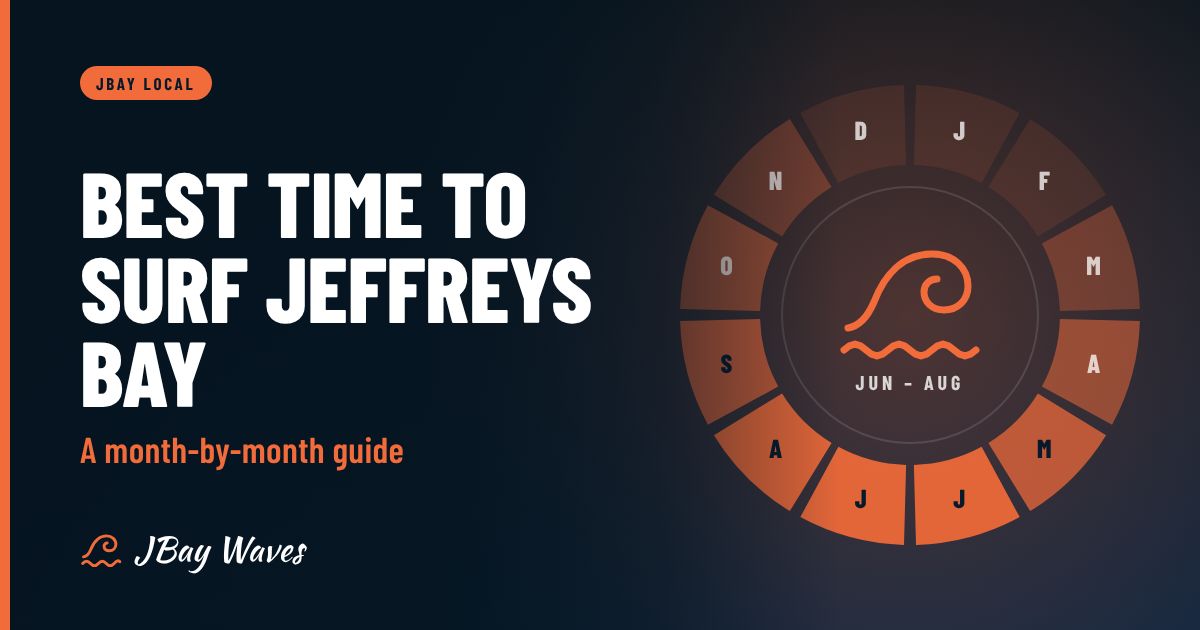
The best time to surf Jeffreys Bay is winter, roughly May to September. That is the easy answer. The useful answer depends on what you want from a trip: the biggest, most reliable swells, quieter line-ups, warmer water, or a mix of all three. J-Bay has surf in every month, but the character of the place changes completely between a July morning on the point and a January afternoon on the beach.
This guide goes month by month through the swell, wind, water and crowds, explains the weather pattern behind them, and finishes with how to choose your dates and what to pack. If you are new to the town, our complete guide to surfing Jeffreys Bay covers the breaks themselves.
The short answer: the best time to surf Jeffreys Bay
- Peak season (June to August): the most consistent south-west groundswell and the most offshore days. Cold mornings on land, busy line-ups.
- Shoulder months (March to May, and September): plenty of good swells with fewer people. March is hit and miss; April and May are more reliable, with milder weather than midwinter.
- Spring (October and November): windier and less reliable, but quiet. Good swells still happen.
- Summer (December to February): small, often wind-affected surf and the warmest water of the year. Best for learners, longboarders and families, with crowds in town over the holidays.
Why winter is J-Bay's season
The point needs south-west groundswell, and in winter the Southern Ocean delivers it in a steady procession. Deep low-pressure systems track eastwards below Africa, and the cold fronts they drag across the Cape send swell up the coast to Jeffreys Bay. Each front also brings a wind sequence that J-Bay surfers learn to read like a clock:
- Before the front: high pressure over the interior and a coastal low ahead of the front set up warm, dry north-westerly to northerly berg winds. They feel offshore on the beach but blow into the face at Supertubes, which is why locals call them devil winds.
- As the front passes: the wind swings west and then south-west, the classic J-Bay wind, often just as the new swell fills in. This is when the point tends to turn on.
- After the front: high pressure ridges in behind it, the wind eases or swings around, and the swell slowly fades until the next system lines up.
In summer the storm track sits further south, swells are smaller and less frequent, and the prevailing wind turns easterly, which is onshore here. Easterlies also cause upwelling along this stretch of coast. They push surface water offshore, cold water rises from below to replace it, and the sea temperature can drop by several degrees within a day or two. Those cold snaps usually last a few days.
One thing winter does not mean here is a rainy season. This coast sits between the winter-rainfall Western Cape and the summer-rainfall east, so rain is spread fairly evenly through the year. In Gqeberha's long-term records August is the wettest month, and even then it averages only around 70 mm.
Jeffreys Bay month by month
The table gives the big picture. Water temperatures are approximate nearshore ranges: satellite averages tend to read a degree or two warmer, and upwelling can push the water well below these numbers for a few days at a time. Air temperatures are long-term averages (NOAA, 1991 to 2020) for Gqeberha, about an hour up the coast.
| Month | Surf | Water (approx.) | Air, day / night | Crowds |
|---|---|---|---|---|
| January | Small, easterly winds | 18 to 22°C | 26 / 17°C | Holiday peak to mid-month |
| February | Small, early sessions best | 18 to 22°C | 26 / 18°C | Quiet in the water |
| March | First autumn swells | 17 to 21°C | 25 / 16°C | Quiet |
| April | Season starts, berg winds | 17 to 20°C | 23 / 14°C | Easter rush |
| May | Swells build, whales arrive | 16 to 19°C | 22 / 11°C | Moderate |
| June | Prime time | 15 to 18°C | 21 / 8°C | Busy once school holidays start |
| July | Prime time, contest month | 14 to 18°C | 20 / 8°C | Busiest |
| August | Prime time, coldest water | 14 to 17°C | 20 / 9°C | Busy |
| September | Still very good | 14 to 17°C | 20 / 11°C | Thinning out |
| October | Shoulder, windier | 14 to 18°C | 21 / 13°C | Quiet |
| November | Smaller, easterlies return | 16 to 19°C | 23 / 14°C | Quiet |
| December | Small, holiday buzz | 17 to 21°C | 24 / 16°C | Busy from mid-month |
January and February
The town is at its busiest over the Christmas holidays, and the surf is usually at its smallest. Easterlies spoil many afternoons, so dawn is your window, and the beach in front of town, Kitchen Windows and The Point are where to look on small days. February is calmer on land once schools are back, with long, warm days. The water is at its warmest in these months until an upwelling event drops it sharply.
March and April
The first autumn swells start to show, and by April the season is under way. This can be the sweet spot: water still in the high teens, mild mornings and thinner line-ups than in July. Early-season berg winds are common, so expect some frustrating days with chop on the face at Supers between the good ones. The Easter school holidays bring a short burst of visitors.
May and June
Now the point comes alive. Swells arrive more often and with more size, and from May the southern right and humpback whales return to St Francis Bay. June is one of the most reliable months of the year for clean, solid surf, with short days and cold mornings on land. The winter school holidays start at the end of the month.
July and August
The heart of winter is the heart of the season, with back-to-back swells and your best chance of the big, lined-up days when Boneyards connects into Supers. July has traditionally been contest month, with the J-Bay Open window bringing pros, media and fans to town. The water reaches its coldest in late July and August, and nights in Gqeberha average around 8°C, so pack something warm for the dawn checks.
September and October
September is still firmly in the season, and the line-ups thin out after the winter rush. Swells become less frequent as the month goes on and spring brings windier days. October is a shoulder month: you might get a week of good surf or a week of wind, but if it pays off you will share it with far fewer people.
November and December
The easterly pattern takes over, swells shrink, and the water can swing between pleasant and surprisingly cold as upwelling kicks in. November is quiet. December starts the summer holidays, when the town buzzes and the beach in front of town fills with families and surf schools. Surf early, then enjoy the rest of the day.
Water temperature and what to wear through the year
J-Bay's water is never tropical. A 4/3 or a warm 3/2 steamer is the usual winter choice, often with thin booties for the mussel-covered rocks. In summer a 3/2 is the safe choice, with a spring suit on warm, windless days, but keep the 4/3 in the car because an easterly can knock several degrees off the sea overnight. Our wetsuit thickness guide for South African water matches suits to temperatures in more detail.
Crowds, holidays and contest season
Crowds at Supertubes follow the swell more than the calendar, and a solid, offshore day in any month brings everyone out. Some periods are reliably busier, though:
- School holidays: mid-December to mid-January, around Easter, a three-week break from late June into July, and a short spring break in late September.
- Contest years: the J-Bay Open has usually run in a July window. It was dropped from the 2026 Championship Tour after funding fell through, and the local boardriders' club organised a residents-only contest at Supertubes for the winter instead. Our history of the J-Bay Open has the full story.
- Peak winter weeks: when overseas surfers arrive for the most reliable swells.
To beat the crowds, surf at first light on weekdays, look beyond Supers to Tubes, The Point and Albatross, and consider the shoulder months.
How to pick your dates
Swell is never guaranteed, so plan for probability rather than certainty:
- Book a window, not a weekend. Ten days to two weeks between June and August gives you a strong chance of at least one proper swell.
- Watch the forecast from home. Big Southern Ocean storms show up on the models up to a week out, and the details firm up over the final few days. Our live Jeffreys Bay surf report shows the next seven days, and our guide to reading a surf forecast explains what to look for.
- Know the J-Bay recipe. A south-west groundswell of 12 seconds or more with a west to south-west wind is the target. On berg wind days, check Kitchen Windows and Magnatubes, which sit at a different angle to the wind and can stay cleaner than Supers in a north-westerly.
- Stay flexible if you can. If you live in South Africa, the classic move is the strike mission: wait for a good forecast, then drive.
What to pack for each season
- Winter: a 4/3 steamer plus a 3/2 for milder days, booties, a beanie and warm jacket for dawn checks, a step-up board and cold-water wax.
- Summer: a 3/2 or spring suit, a rash vest and plenty of sunscreen, a longer board for small days, and the 4/3 in case of upwelling.
- All year: a ding repair kit, a spare leash and fins, antiseptic for reef cuts, binoculars for the viewing deck, and a couple of Live By The Tide tees for the braai.
For a printable summary of the breaks, the seasons and the local know-how, download our free J-Bay Surf Guide.
If you can only make one trip, aim for two weeks between June and August, bring a 4/3 and a step-up, and keep an eye on the forecast from the moment you book. If crowds bother you more than size, try April, May or September. And if you just want warm days, small waves and a holiday atmosphere, come in summer and surf at sunrise.